The Great Liberation That Wasn't
Once upon a time, getting dressed for work was simple. You wore a suit. Done. The suit might have been uncomfortable, expensive, or completely impractical for your actual job, but at least you knew what was expected. Then some well-meaning executive decided that maybe, just maybe, people could be trusted to dress themselves like adults.
Enter business casual: the dress code equivalent of "some assembly required" instructions written by someone who clearly never intended to assemble the product themselves.
The Interpretation Olympics
Business casual is less a dress code and more a philosophical exercise. It's the workplace equivalent of modern art—everyone sees something different, and nobody wants to admit they don't get it.
Jeans are sometimes okay, but not those jeans. Sneakers are fine, but not those sneakers. Polo shirts are acceptable, unless they're too casual, but dress shirts might be too formal, unless it's Tuesday, or there's a client meeting, or Mercury is in retrograde.
Every office has that one person who pushes the boundaries like they're conducting a sociological experiment. They show up in something that technically meets every stated requirement while somehow violating the entire spirit of professional dress. They're not wrong, but they're not right either, and they've turned getting dressed into performance art.
The Regional Variations
Business casual in Silicon Valley means a hoodie that costs more than most people's rent. Business casual in Manhattan means something entirely different. Business casual in Dallas has its own rules, and business casual in Portland probably involves flannel somehow.
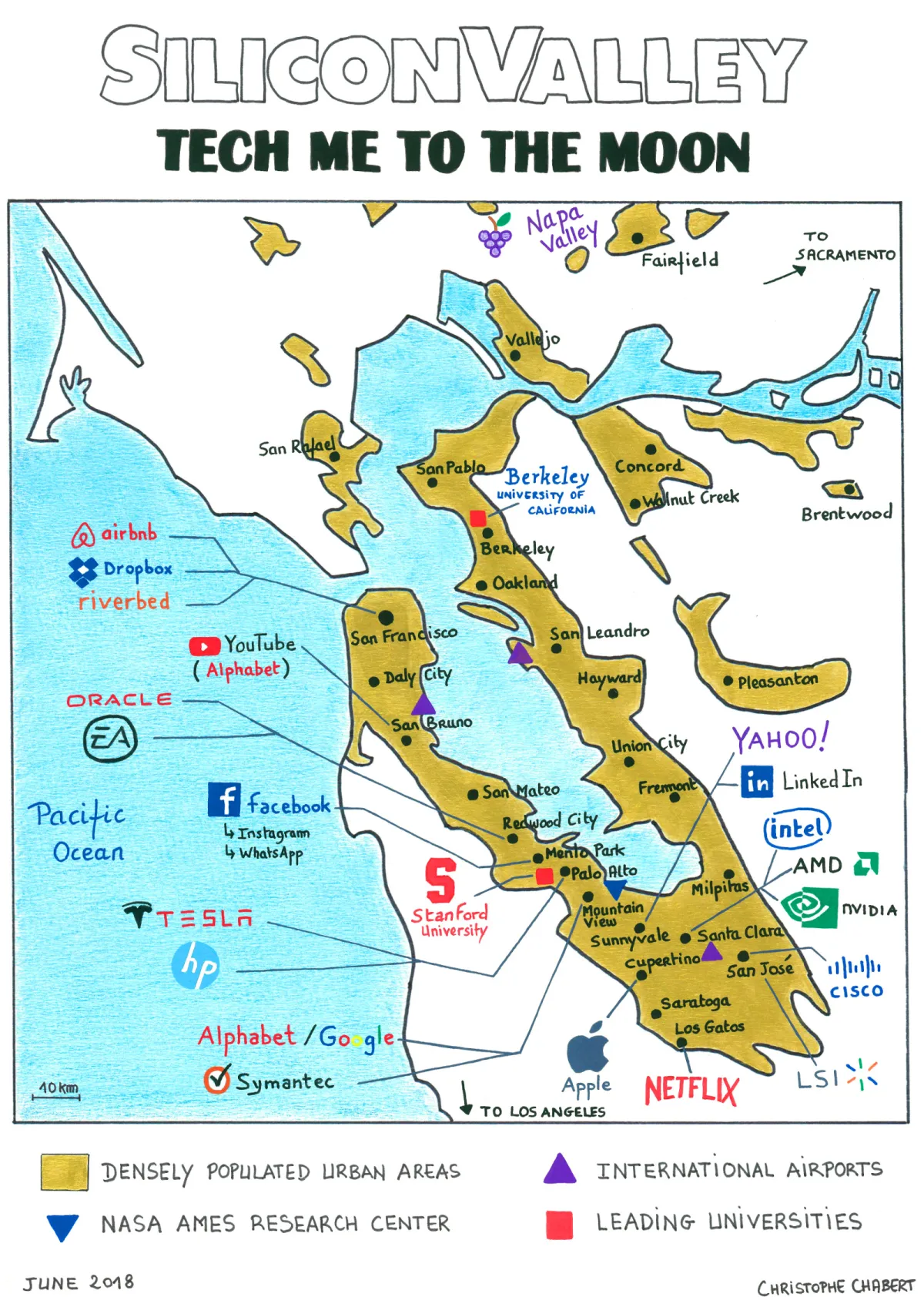 Photo: Silicon Valley, via mindthemap.fr
We've created a system where you need a decoder ring just to figure out what "appropriate attire" means in your specific zip code. It's like fashion regionalism, but with more anxiety and fewer clear guidelines.
The Friday Wildcard
And then there's Casual Friday, which somehow makes everything more complicated. If Monday through Thursday is business casual, what exactly is casual casual? Are we talking pajamas? Athleisure? Full-on vacation wear?
Casual Friday was supposed to be a gift, but it's really just another puzzle to solve. You spend Thursday night calculating exactly how casual is too casual, like you're defusing a bomb made of cotton blends and workplace social dynamics.
The Remote Work Plot Twist
Then 2020 happened, and suddenly everyone was attending board meetings in sweatpants. The great work-from-home experiment revealed that maybe, just maybe, what we wear has less impact on productivity than we thought.
But now we're back in offices, and the rules have somehow become even murkier. We've all seen what peak comfort looks like, and it's not business casual. It's not even casual casual. It's the clothes you wear when nobody's watching, and they were glorious.
The Accessories Arms Race
When the actual clothes are confusing, accessories become the secret weapon. A blazer can make anything look intentional. The right shoes can elevate an outfit from "did they sleep here?" to "clearly management material."
Watches, bags, belts—they're all part of the complex signaling system that is modern office attire. You're not just getting dressed; you're sending coded messages about your career ambitions, your attention to detail, and your understanding of unspoken social contracts.
The Generational Divide
Millennials learned business casual during the recession, when any job was a good job and you dressed accordingly. Gen Z entered the workforce during peak remote work and has a fundamentally different relationship with professional attire.
Gen X remembers when business casual was revolutionary. Baby Boomers remember when it was controversial. And now we're all in the same office, interpreting the same dress code through completely different cultural lenses.
The HR Tightrope
Human Resources departments across America are performing daily miracles, trying to enforce dress codes that make sense without actually making sense. They're the referees in a game where nobody agrees on the rules, and the rulebook was written by committee in 1987.
"Use your best judgment" has become the corporate equivalent of "figure it out yourself," and everyone's best judgment is apparently different.
The Solution That Isn't Coming
Here's the thing: business casual isn't going anywhere. It's too entrenched, too convenient for employers, and too psychologically complex for anyone to solve definitively.
We're stuck in this middle ground between formal and casual, professional and personal, trying to look like we take our jobs seriously while also being comfortable enough to actually do them.
The Daily Dance
So every morning, millions of Americans perform the same ritual. They stand in front of their closets, calculating the weather, their meeting schedule, their office culture, and their personal tolerance for judgment, trying to solve a puzzle that has no correct answer.
Business casual broke America not because it was too permissive or too restrictive, but because it asked us to make daily decisions about things that used to be decided for us. And as it turns out, we're all terrible at it.
But we keep trying, because the alternative is going back to suits for everyone, and nobody wants that. So we'll continue this elaborate dance, this daily negotiation between comfort and professionalism, between individual expression and corporate conformity.
Business casual: the dress code that promised freedom but delivered anxiety. Welcome to modern America, where even getting dressed is complicated.