Fifty Shades of Beige: How the Capsule Wardrobe Stole My Entire Personality
It started, as all great tragedies do, with a Pinterest board.
Somewhere between a minimalist flat lay of a single white linen shirt and a quote about 'buying less but buying better,' I became convinced that my wardrobe was the problem. Not my credit card debt. Not my inability to wake up before 8:47 a.m. My wardrobe. Specifically, the fact that it contained color, pattern, and what the capsule wardrobe evangelists on YouTube call 'noise.'
So I did what any reasonable person does at 11 p.m. on a Tuesday: I purged everything.
The Great Neutralization
The capsule wardrobe philosophy, for the uninitiated, goes something like this: curate ten to fifteen timeless, high-quality pieces in a cohesive neutral palette, and you'll never experience the agony of not knowing what to wear again. You'll look effortlessly put-together. You'll feel calm. You'll probably start drinking more water and calling your mother.
The influencers selling this vision are always photographed in airy apartments with exposed brick and a single orchid. They hold a ceramic mug with both hands. Their closets are organized by gradient. They appear to have achieved a level of inner peace that no one who still owns a 2019 novelty graphic tee could possibly access.
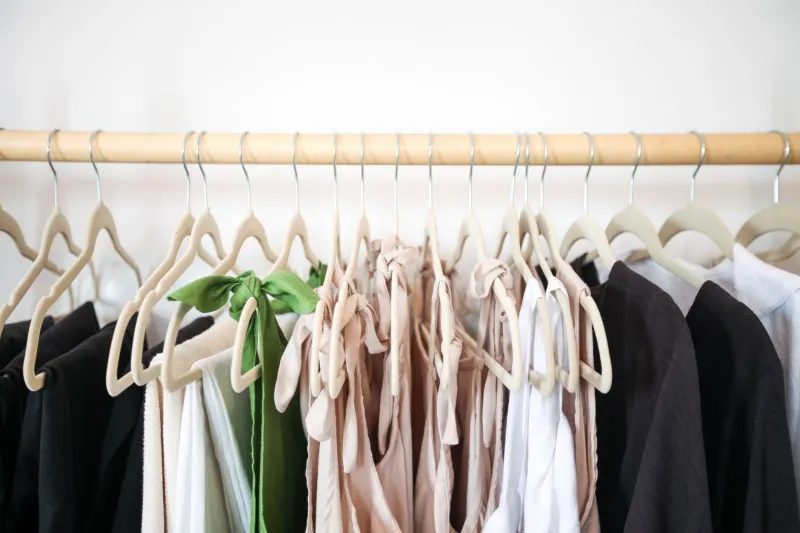
I donated the novelty tee. I donated seventeen other things that 'didn't serve the vision.' I bought a sand-colored blazer, two white shirts, a pair of straight-leg dark jeans, some camel trousers, and a cream ribbed sweater that the product description called 'cloud-like' but which I would later describe as 'the color of an unflavored rice cake.'
My closet looked extraordinary. Serene. Like a very expensive waiting room.
I looked like a sentient oatmeal container.
Everything Coordinates, Nothing Communicates
Here's the thing nobody tells you about the capsule wardrobe: it works. Technically. Everything genuinely does go with everything else, because everything is essentially the same color with minor variations in texture. Getting dressed in the morning takes approximately forty-five seconds. You will never again stand in front of your closet at 7 a.m., paralyzed by the existential weight of choosing between the floral midi skirt and the corduroy blazer.
You will also never experience joy.
The floral midi skirt was a relic from a trip to a vintage market in Austin. The corduroy blazer was a thrift find that made exactly one person at a house party say, 'okay, I see you.' Both of them were 'noise.' Both of them are gone. What replaced them coordinates beautifully and communicates absolutely nothing about who I am, where I've been, or what I think is funny.
A capsule wardrobe is the sartorial equivalent of a LinkedIn profile. Technically impressive, carefully optimized, and completely devoid of anything that would make someone want to have dinner with you.
The Slow Creep of the Beige Cult
The really insidious part is how reasonable the whole process feels while it's happening. You're not being told to become boring. You're being told to become intentional. These are very different things, linguistically. In practice, they produce the same result: a person who looks like they shop exclusively at one store and have strong opinions about linen quality.
Every piece you remove has a perfectly logical justification. The sequined skirt? Too occasion-specific. The vintage band tee? 'Not aligned with the aesthetic.' The bright red coat that made you feel like a movie character every single time you wore it? 'A statement piece that dominates the palette.'
Gone. All of it. Gone in the name of freedom.
I wore my capsule wardrobe for three months. In those three months, not a single person asked me where anything was from. Not one compliment. Not one double take. I was aesthetically inoffensive and entirely invisible, a beige ghost drifting through coffee shops and open-plan offices, blending into every neutral-toned interior like a very well-dressed piece of furniture.
The Case for Keeping the Chaos
Here's my official, half-serious, entirely heartfelt defense of the weird stuff: your clothes are doing something the capsule wardrobe crowd refuses to acknowledge. They're talking.
The lime green windbreaker you bought on a whim tells people you're willing to take a risk. The deeply impractical heeled boots you wear to the grocery store tell people you have a sense of humor about yourself. The vintage Hawaiian shirt you've owned since college tells people you have a history, a timeline, a whole life that predates your current aesthetic phase. These things start conversations. They attract your people. They repel the wrong ones, which is honestly a service.
A capsule wardrobe tells people you read the same articles they read and made the same decisions. It's a uniform for people who think they're opting out of uniforms.
I'm not saying burn the white linen shirt. Keep the white linen shirt. It's a great shirt. But keep the sequined skirt too. Keep the red coat. Keep the thing that made someone laugh once, or made you feel like a completely different version of yourself, or that you bought in a city you loved and can't quite explain.
Your wardrobe is not a problem to be solved. It's a document. And documents with personality are always more interesting than the ones that have been edited down to nothing.
I'm rebuilding the chaos. Slowly, deliberately, and in full color. The oatmeal container is retired.
The vintage blazer is back.