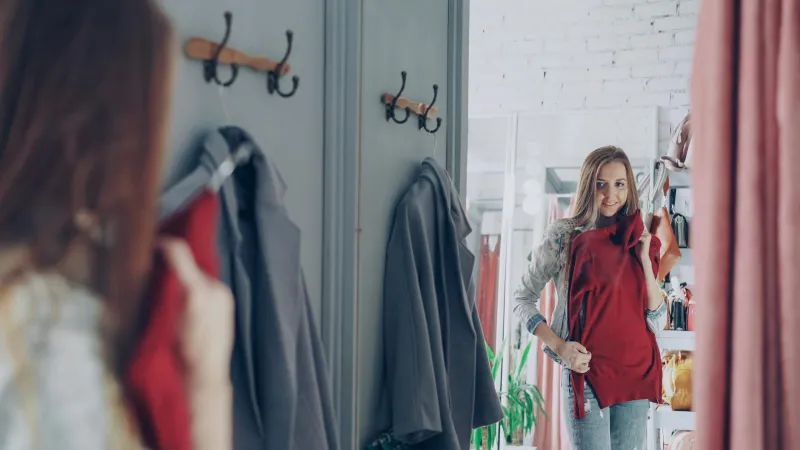
The Scene of the Crime
Walk into any department store dressing room and you're immediately transported to what appears to be a medical examination facility designed by someone who's never seen natural light. The fluorescent bulbs buzz overhead like angry wasps, casting a greenish pallor that makes everyone look like they're starring in a zombie movie.
This isn't an accident. This isn't poor planning. This is a carefully orchestrated psychological operation designed to make you question everything about your life choices while holding a pair of jeans that looked perfectly reasonable on the hanger.
The Lighting Conspiracy
Let's start with the obvious villain: the lighting. Whoever decided that fluorescent tubes were the appropriate illumination for a space where people make appearance-based decisions was either deeply confused about human psychology or actively malicious.
Fluorescent lighting doesn't just make you look bad; it makes you look specifically bad in ways that natural light would never reveal. It emphasizes shadows under your eyes, turns your skin tone into something vaguely cadaverous, and somehow makes every outfit look like it was purchased at a gas station.
The cruel irony is that the same stores spending millions on atmospheric lighting in their main shopping areas — warm, flattering, carefully positioned to make everything look appealing — apparently run out of budget the moment you step behind a curtain.
The Mirror Situation
If the lighting is the prosecution, the mirrors are the hostile witnesses. These aren't regular mirrors; these are funhouse mirrors disguised as regular mirrors, positioned at angles that would make a geometry teacher weep.
The three-way mirror setup is particularly diabolical. It's designed to show you angles of yourself that you've never seen and, frankly, never needed to see. It's like having a panel of judges evaluating your life choices from every possible perspective, all of them unflattering.
And then there are the individual mirrors — warped slightly, positioned too high or too low, reflecting back a version of yourself that's somehow both too wide and too narrow simultaneously. It's like looking at yourself through the lens of your worst insecurities.
The Space-Time Continuum Problem
Dressing rooms exist in their own dimension where normal rules don't apply. Time moves differently in there. What feels like five minutes of trying on clothes is actually forty-seven minutes of existential crisis. The space is simultaneously too small to move around in and too large to feel cozy.
The curtains never quite close all the way, creating that special anxiety of wondering if strangers are getting glimpses of your underwear while you wrestle with a dress that seemed so promising on the rack.
The hooks are positioned with the precision of someone who's never actually hung up clothing. Too high, too low, or at exactly the right height to catch your sleeve and send everything tumbling to the floor.
Why Retailers Keep It This Way
Here's the thing that makes the whole experience even more maddening: retailers know exactly how terrible their fitting rooms are. They've known for decades. Customer surveys consistently rate dressing room experiences as the worst part of shopping, and yet nothing changes.
The cynical truth is that bad fitting rooms serve a purpose. When you look terrible in everything, you're more likely to make quick decisions and less likely to be picky. You'll grab whatever fits reasonably well and get out of there before the fluorescent lights can do any more damage to your psyche.
It's also about inventory turnover. If people spent comfortable amounts of time carefully considering each item, trying multiple sizes, and really evaluating their choices, the fitting rooms would be constantly occupied and sales would slow down.
The Psychological Warfare
The modern fitting room is essentially a masterclass in psychological manipulation. It's designed to make you feel rushed, insecure, and eager to make a purchase decision — any purchase decision — just to escape.
The harsh lighting makes everything look worse, so when you find something that looks merely okay, it feels like a victory. The uncomfortable environment makes you want to grab whatever works and leave, rather than taking the time to really consider if you love something.
It's retail Stockholm syndrome: the fitting room traumatizes you, and then any piece of clothing that doesn't make you look completely horrible becomes your savior.
Survival Strategies for the Modern Shopper
Knowing you're entering hostile territory, you can prepare accordingly. Bring your own lighting — seriously. Phone flashlights can provide more natural illumination than whatever's buzzing overhead.
Try things on at home whenever possible. Many retailers now offer generous return policies that make it easier to order multiple sizes online and return what doesn't work. Your bedroom mirror and natural lighting will give you a much more accurate picture than any fitting room.
When you do brave the dressing room, remember that the person in the mirror isn't really you — it's you filtered through the worst possible lighting and reflected in questionable mirrors. If something fits well and feels comfortable, trust that over what you're seeing.
The Verdict
The American fitting room experience is broken by design. It's a relic of a retail philosophy that prioritizes quick turnover over customer satisfaction, and somehow we've all just accepted it as normal.
Until retailers decide that customer experience matters more than psychological manipulation, we're stuck navigating these fluorescent chambers of judgment. The least we can do is recognize them for what they are: not a reflection of how we actually look, but a carefully constructed environment designed to make us feel bad about ourselves.
The next time you're standing in a dressing room wondering how you look so terrible in everything, remember: it's not you, it's the lighting. And the mirrors. And the entire concept of the American fitting room experience.
The real crime isn't how you look in there — it's that we've all agreed to pretend this is normal.